I have open-sourced issac-harness, a verification and dataset-qualification harness for OpenUSD environments running on NVIDIA Isaac Sim 6.2 and Isaac Lab 3.0.
We built it because OpenUSD and Omniverse Replicator fail silently. A script exits 0 and produces crisp ray-traced PNGs while segmentation masks have holes, camera metadata is off by 100×, physics resets launch objects before step 1, or models trained on the output score 0.00% AP on real photographs. Coding agents make this worse: without fast, deterministic checks that exit 1, an agent happily scales a broken scene to 50,000 frames.
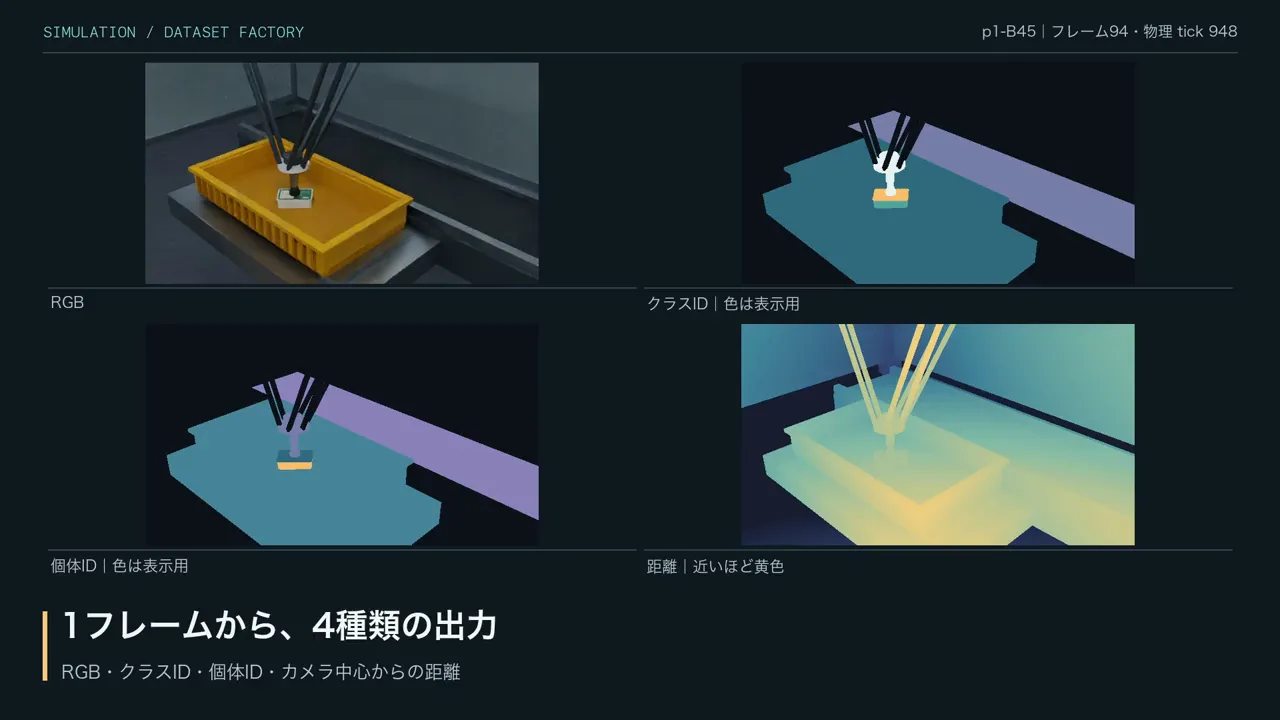 Tick-synchronized 4-modal output from a single 120 Hz physics frame: RGB, semantic class ID, instance ID, and metric distance from camera center
Every module in harness/ and every rule in AGENTS.md corresponds to a concrete mistake we hit on macOS and on a single GCE NVIDIA L4 GPU (Isaac Sim 6.2.0, Replicator 1.13.38, Isaac Lab 3.0.0). Below are four of those failure modes and the exact measurements behind them.
1. A 13,738-Pixel Mask Hole That Cross-Checking Annotators Missed
To vary package appearance, we placed a 60 x 37 mm handling mark 0.8 mm above the front wall of a cardboard carton and toggled its visibility across frames.
In a fixed-camera, fixed-pose, fixed-lighting close-up, toggling that mark from hidden to visible turned 13,738 pixels underneath the mark from the carton class into background (0)—leaving only 490 of the 14,228 mark-ROI pixels assigned to the owner box.
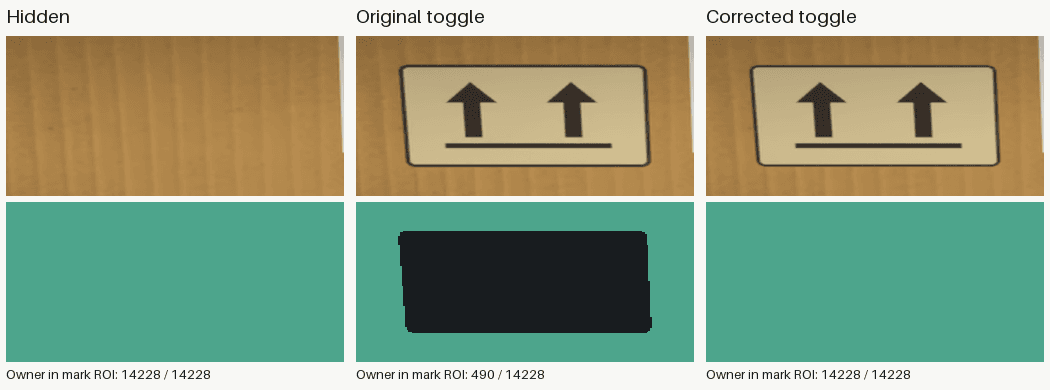 Fixed close-up decal invariance check: the original visibility toggle erases 13,738 carton pixels underneath the mark (center, 490/14228), while keeping the mark registered and parking it behind the camera preserves all 14,228 pixels (right)
Three properties made this bug deceptive:
- Both semantic and instance segmentation outputs had the exact same hole. Comparing class masks against instance masks passed every pixel because both annotators agreed on the wrong answer.
- Order mattered. Starting visible and hiding the mark did not corrupt the mask; starting hidden and showing it mid-run did.
- Alpha blending was not the cause. Converting the RGBA texture into an opaque quad cutout mesh at
alpha_cutoff = 128(withopacitydisconnected) still erased 13,670 pixels of the carton underneath.
Eliminating mid-run visibility state changes fixed it: issac-harness keeps child mark prims permanently visible and registered to RTX from startup, parking unused marks behind the active camera on frames where they are turned off. We paired that fix with [[appearance_pairs]] (campaign label-invariance), which captures off -> on -> off sequences under a locked camera and fails unless RGB changes while class and instance masks remain pixel-identical.
Locked 3-frame close-up (off -> on -> off) | Visibility toggle | Always-registered + parked behind camera |
|---|---|---|
| Carton pixels flipped to background | 13,738 px (13,670 px opaque cutout) | 0 px |
| Carton pixels with RGB delta above 0.10 | — | 13,016 px / 13,021 px |
| Max radial range delta from optical center | — | 0.851 mm (authored offset: 0.8 mm) |
2. Config-Level "Diversity" Lies and UV Tile Traps
Two authoring bugs repeatedly inflated apparent dataset quality before we added static checks:
- Distinct finish names pointing to identical pixels: Defining
paper_01throughpaper_08in a config file does not mean a training run saw eight materials.[min_distinct_texture_sets]inqualification.pyignores config labels and counts unique SHA-256 tuples of the base-color, roughness, and normal image files actually bound across rendered frames. - Tiled decals and missing UV wrap modes: Baking a shipping stamp into a tiled cardboard base color duplicates that stamp onto interior flaps and side walls. Conversely, when our studio table's UV coordinates extended past
[0, 1]without explicitwrapS/wrapTrepeat modes, the outer table rendered black while the lit region blew out—95.16% of support-surface pixels hit250/255or higher (median sRGB1.00). Setting an explicit0.16 mpaper tile repeat and cutting the two studio lights to1/4dropped saturated pixels to 0.00% (median sRGB0.622) with zero pixel change in instance masks.
campaign texel-check now computes worst-direction texels/m in world meters across every mesh face, and harness.surface_mark authors single-occurrence marks onto one validated planar convex quad.
3. Negative Controls for Grasping and Suction Boundaries
Physics trials also produce false positives whenever you test only the happy path.
In Isaac Lab 3.0.0 (PhysX, 360 steps at 1/120 s), we tested lifting a carton with a kinematic two-finger gripper. Running an open-finger negative control along the exact same lift trajectory revealed that the carton flew upward even when the fingers stayed open: immediately after reset, both fingers collapsed to the world origin and struck the box before step measurements began. Verifying finger pose, drive targets, and zero velocity prior to measurement produced clean separation across all four contact trials:
| Isaac Lab trial (360 steps @ 120 Hz) | Measured result |
|---|---|
| Lateral rim impact (GPU PhysX) | Incident 0.712 m/s -> rebound -0.142 m/s (speed ratio 0.200) |
| Handset slide deceleration (GPU PhysX) | Effective kinetic friction 0.655 (11-point velocity fit RMS 0.0000045 m/s) |
| Closed-finger lift & release (CPU PhysX) | Mean hold height 179.39 mm, post-release drop 179.39 mm |
| Open-finger negative control (CPU PhysX) | Same lift trajectory; carton rise under 0.001 mm |
The same discipline applies to vacuum Surface Gripper cells. In our overhead food-pack transfer trial—switching from a 35 mm tall pack to a 30 mm tall pack—rotating the smaller pack by 45° leaves the 34 mm suction cup center still over the lid while its outer lip overhangs the valid seal zone by -4.7 mm. Instead of faking picks by parenting the rigid body to the tool, the trial logs rim-margin geometry on the 120 Hz physics clock, aborts closure on negative margin, shifts +13.0 mm toward lid center, and verifies single-retry recovery.
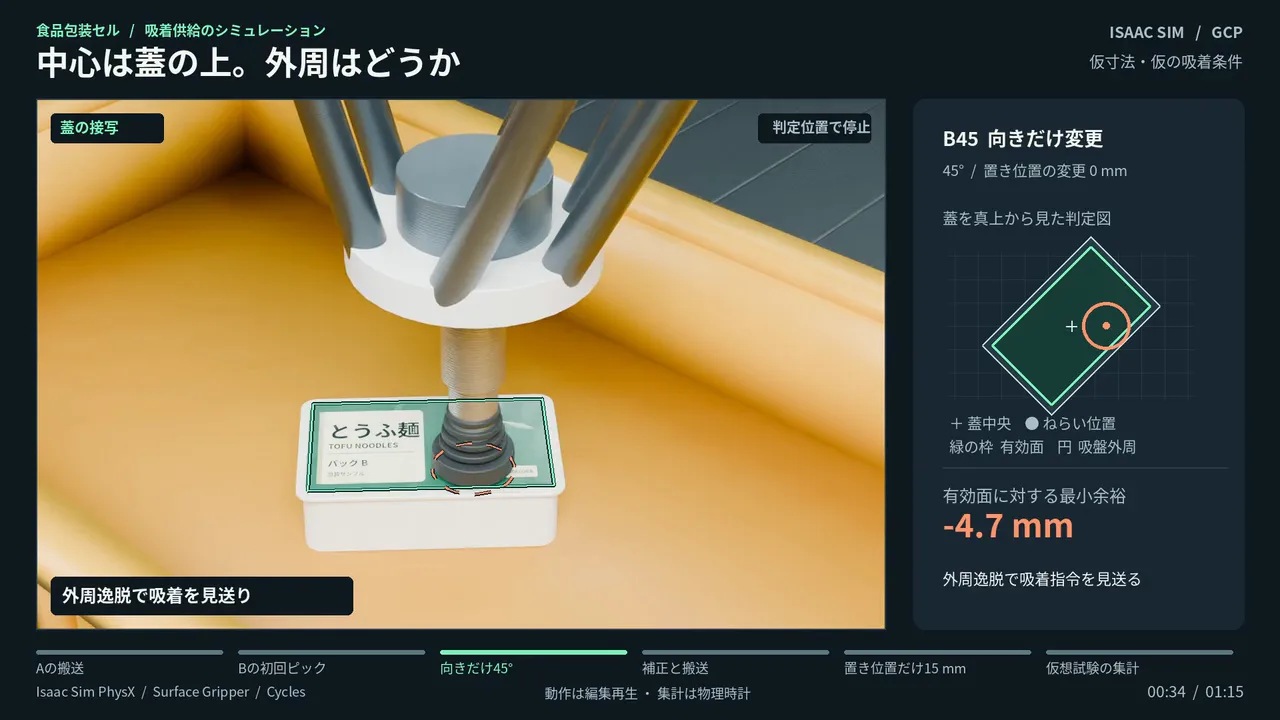 Overhead packaging suction boundary audit: on a 45-degree rotated pack, the cup center lands on the lid while its 34 mm outer lip overhangs the valid seal boundary by -4.7 mm, triggering a safe abort and +13.0 mm retry
(Scope boundary: simulated friction, rebound, and geometric rim-seal gates reflect PhysX and authored rigid bodies; flexible film wrinkling and vacuum pressure rise require hardware calibration.)
4. 1.55 mm Depth Alignment—and a Failed Release Gate
On GCE (g2-standard-8, one NVIDIA L4), we generated 256 frames at 960 x 720 across 4 camera families, 4 layouts, and 6 classes (1,469 visible instances, RTX Path Tracing at 16 spp) and ran campaign release against our pre-committed examples/campaign/release.toml.
Determinism and 3D registration passed:
- Independent Kit process replay (3 frames): normalized sRGB RMSE was
0.00315,0.00584, and0.00410; minimum visible instance IoU was1.0; range difference was0.0 m. - Registered RGB-D comparison on held-out BOP YCB-Video (2 sequences, 6 views): silhouette IoU hit
0.990and0.940(policy>= 0.80), and median optical-axis depth error was1.55 mmand1.61 mm(policy<= 15.0 mm).
Even so, campaign release exited 1 and rejected the dataset:
| Qualification check | Pre-committed policy | Measured | Verdict |
|---|---|---|---|
| Silhouette IoU (2 held-out YCB sequences) | at least 0.80 | 0.990 / 0.940 | Pass |
| Median optical-axis depth error | at most 15.0 mm | 1.55 mm / 1.61 mm | Pass |
| Interior sRGB mean absolute difference | at most 0.10 | 0.178 / 0.244 | Fail |
| Real-image detection macro AP50 (88 YCB frames, SIFT) | at least 50.0% | 24.94% (synthetic holdout: 32.44%) | Fail |
| Real-image detection macro AP50 (SSDLite from scratch) | diagnostic | 0.00% (synthetic holdout: 19.84%) | — |
| Full-resolution visual review (4 frames) | 4 / 4 pass | 1 pass, 3 fail | Fail |
Bracketing exposure on two calibration photos (1/16 scale; the tool aborts if calibration and evaluation reference the same frame) cut initial overexposure from 0.475 / 0.391 to 0.178 / 0.244, still short of 0.10 due to localized can/drill speculars and bottle shading. Worse, a randomly initialized SSDLite320-MobileNetV3 trained from scratch on 192 synthetic frames achieved 19.84% macro AP50 on the 64-frame synthetic holdout layout, yet produced 2,756 cracker-box predictions with zero IoU >= 0.50 matches (0.00% AP) on 88 byte-deduplicated real YCB frames.
Had we evaluated only on synthetic holdout splits—or lowered release.toml after seeing the numbers—this run would have looked like a working pipeline. Blocking release with full SHA-256 provenance is the point of the harness.
Run It Locally
Static OpenUSD checks, Blender Cycles baseline renders, and the 99-test local suite run on macOS or Linux without an NVIDIA GPU:
git clone https://github.com/ekusiadadus/issac-harness.git
cd issac-harness
uv sync --locked
uv run --locked python -m harness check examples/inspection
uv run --locked python -m harness render examples/inspection --capture-only --out out/first-review
uv run --locked python -m pytest -q
All L4 artifacts, failure diagnostics, and raw Kit/PhysX logs are archived under evidence/campaign-l4/ and evidence/gcp-l4/.
- GitHub: ekusiadadus/issac-harness